

Yes, Your Grace 2: Snowfall puts players in charge of Davern, a troubled kingdom where every royal decision carries a price. Developed by Brave At Night and originally released for PC on 8 May 2025, this story-driven management game also reached mobile devices, bringing its mixture of family drama, political disputes and resource management to a wider audience. Rather than building armies through constant battles, players spend much of their time listening to petitioners, employing royal agents, managing the treasury and preparing for problems that may not become obvious until several weeks later. The challenge is not simply keeping everyone happy. It is knowing when to spend, when to refuse assistance and how to protect the kingdom without sacrificing the people who depend on its ruler.
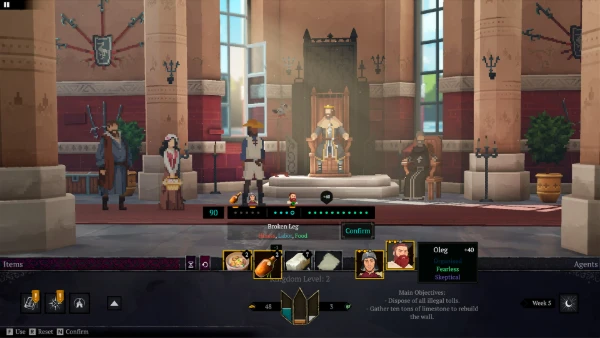
The story continues the events of the original Yes, Your Grace, returning to the royal family of Davern and the difficult responsibilities of maintaining a kingdom. Its world draws heavily on Slavic folklore, combining ordinary disputes between villagers with unusual creatures, mysterious events and political threats. The central gameplay takes place around the throne room, where visitors arrive with requests for money, supplies, protection or assistance. Some problems are straightforward, while others involve hidden motives or consequences that extend beyond the current week. The order of many petitions varies between playthroughs, so memorising a single sequence is less useful than learning how to judge each situation. A good ruler must understand the needs of the population without allowing every visitor to dictate royal policy.
Kingdom management follows a weekly rhythm. During audiences, decisions affect the resources and reputation available to the crown, while the end of the week provides an opportunity to organise finances, employ agents and prepare for future responsibilities. One particularly important feature is the relationship between Prestige and Prosperity. Successful actions can improve the kingdom’s standing, helping generate Prosperity that is subsequently allocated to Gold and Supplies. These resources serve different purposes, so an impressive financial position does not automatically mean the kingdom is prepared for every emergency. Players must also consider Happiness, Influence and the availability of trusted helpers. Understanding these connections makes the game considerably easier than responding to every problem individually.
Unlike traditional kingdom-building games, Snowfall does not ask players to construct an enormous settlement or control individual workers. Most important decisions are presented through conversations, character interactions and the management of available assistance. Taxes, laws and improvements provide additional ways to influence Davern’s future, but none eliminates the need to make difficult choices. A decision that appears reasonable during one audience may become expensive when the next petitioner arrives. The most reliable approach is to think beyond the immediate reward and consider what the kingdom will need during the coming weeks. Keeping a small reserve, paying attention to recurring problems and recognising which requests affect long-term stability are more valuable than attempting to satisfy everyone.
Petitions form the heart of the experience, but they should not all receive equal treatment. Some visitors describe genuine emergencies involving illness, dangerous animals, food shortages or attacks. Others make questionable claims, request unnecessary assistance or attempt to exploit the generosity of the crown. Before agreeing to a request, consider whether the situation is urgent, whether the proposed assistance is appropriate and what the kingdom receives in return. Helping an endangered settlement may protect future stability, while paying for an unconvincing personal complaint could achieve very little. Refusing assistance is sometimes necessary, although repeated unpopular decisions can damage Happiness and make the overall management of Davern more difficult.
The game also includes suspicious petitions where identifying deception is more important than providing resources. Certain visitors present stories designed to persuade the ruler to offer help without sufficient evidence. These encounters reward careful reading rather than automatic generosity. Consider whether the account makes sense, whether the requested payment seems proportionate and whether an available agent could resolve the matter more effectively. Conversely, not every strange request is fraudulent. Davern’s folklore-inspired setting means that unusual animals, supernatural disturbances and apparently impossible events can be genuine concerns. Treating every peculiar visitor as a liar can be just as damaging as accepting every story without question.
A practical way to approach the throne room is to separate requests into immediate dangers, useful opportunities and matters that can reasonably be refused. Serious threats to public safety usually deserve attention, particularly when the right specialist can resolve them efficiently. Requests connected to future benefits may also justify spending resources, provided the treasury can afford the cost. Minor personal disputes require more discretion. Importantly, there is no need to achieve a perfect result from every audience. Snowfall is designed around competing demands, and some losses are unavoidable. Preserving enough resources for essential obligations while maintaining reasonable public confidence is a more sustainable objective than pursuing maximum approval after every decision.
Effective resource management begins with understanding how the kingdom’s economy operates. Prestige contributes to Prosperity, which players distribute between Gold and Supplies during the weekly planning stage. Gold pays for purchases, financial assistance and the employment of royal agents, while Supplies are particularly important for expeditions and other activities requiring provisions. Prosperity allocated during this stage does not simply remain available for indefinite use, making weekly planning an important responsibility. Spending everything on Gold may leave the kingdom short of Supplies when an expedition becomes necessary. Allocating too much to provisions, however, can make it difficult to maintain the royal staff. Neither resource should be considered more valuable in every situation.
The safest financial approach is to begin each week by identifying unavoidable expenses. Agent payments deserve particular attention because specialists are among the most effective ways to resolve petitions without relying entirely on direct resource expenditure. Players should then consider known expedition requirements, purchases and any major obligations suggested by the story. Remaining resources can be used to assist petitioners or respond to unexpected developments. For example, maintaining enough Gold to employ useful agents may be more beneficial than granting several minor requests that offer only small short-term improvements. Similarly, keeping a reasonable stock of Supplies provides flexibility when a valuable opportunity appears on the kingdom map.
Happiness and Influence add another layer to the economy. Successful decisions can improve public confidence and the kingdom’s reputation, while certain actions contribute towards Influence that supports further development. As Davern progresses, players can enact laws that provide useful advantages. Such improvements should be selected according to the problems the kingdom actually faces rather than simply because they become available. If too many petitions require specialists, a law that increases access to agents may be particularly valuable. Taxation presents its own dilemma: collecting additional revenue can address financial pressure, but the broader consequences of royal policy still require consideration. The strongest economy is not necessarily the one with the most Gold at a particular moment, but the one capable of responding to several different problems.
Royal agents are essential because their skills provide alternatives to spending money or supplies directly. Snowfall includes specialists suited to different situations, including combat, medical concerns, animals and investigations. Characters such as Stan, Alena and Oleg can be especially useful when requests match their abilities. A dangerous creature may require a different approach from an unexplained illness or a violent dispute. Using an appropriate specialist can improve the result of a petition and help preserve valuable resources. However, agents require employment and attention to their Satisfaction, meaning the kingdom cannot depend on their services without proper planning. Keeping useful characters available is generally more effective than spending every coin on immediate demands.
Agent selection should reflect the problems expected during the coming week. Before committing funds, review available information and consider which skills are likely to be needed. A medical specialist may be valuable when illness-related requests are expected, while a fighter offers greater flexibility when threats involve violence. Sending a suitable agent can also provide better results than assigning someone whose abilities do not match the problem. Equipment and consumable items offer alternative solutions to certain petitions, including medicine, weapons and provisions. These options matter when the appropriate specialist is unavailable or when preserving an agent’s availability for another task would be wiser. Choosing between an agent and an item is therefore another form of resource management.
Expeditions create additional opportunities but require careful preparation. Travelling across the kingdom can advance important quests, reveal new information and provide useful rewards, yet exploration consumes Supplies and may involve characters who are needed elsewhere. It is worth checking the available provisions before beginning an assignment rather than assuming the treasury can compensate for every shortage. Planning also means recognising when a story-related task deserves priority over a minor petition. Some expeditions contribute to larger problems affecting Davern, and postponing them simply to conserve resources may create difficulties later. A balanced approach keeps enough Supplies for important journeys, maintains a reliable group of agents and avoids using every available option on requests that offer little lasting benefit.
The hardest part of Yes, Your Grace 2: Snowfall is dealing with decisions that have no entirely satisfactory outcome. The ruler may have to choose between helping a struggling family and preserving resources for a larger emergency, or between satisfying influential figures and maintaining the confidence of ordinary citizens. These situations are complicated by incomplete information. Petitioners naturally present events from their own perspective, and the true significance of a request may only become clear later. Rather than looking for an obviously correct answer, players should consider which outcome best supports their broader priorities. Protecting Davern requires an understanding that compassion, financial responsibility and political survival do not always point towards the same choice.
One useful strategy is to distinguish between reversible mistakes and decisions that may affect the story for a long time. Losing a modest amount of Gold can often be managed through future Prosperity, but damaging a relationship or ignoring a serious threat may have consequences that cannot be corrected so easily. Pay particular attention to dialogue involving important characters, continuing investigations and developing conflicts. A decision with a small immediate cost may be worthwhile if it protects an important relationship or prevents a larger problem. At the same time, a seemingly profitable choice can be questionable if it undermines the kingdom’s stability. Snowfall rewards players who consider the circumstances surrounding each decision rather than focusing exclusively on the resources displayed on screen.
Preparation is especially important as political tensions and military concerns become more significant. The game allows players to develop relationships, make alliances and influence who will support Davern during future confrontations. These responsibilities should not be ignored while dealing with daily complaints. Agents may have personal stories and difficult choices of their own, and the assistance they provide can become important beyond routine petitions. Maintaining good relationships requires attention to their individual circumstances rather than treating them as interchangeable workers. The wider story also demonstrates that seemingly separate problems can become connected. A kingdom that has spent every available resource on short-term approval may find itself poorly prepared when a larger threat finally arrives.
The royal family provides an important emotional centre for Snowfall. Alongside the responsibilities of government, players follow the lives of Davern’s rulers and children as they deal with uncertainty, personal disagreements and the consequences of earlier events. These scenes are not merely interruptions between management tasks. They give context to the kingdom’s difficulties and influence how players understand the people involved in the story. Family conversations deserve the same attention as political negotiations because important developments may emerge outside the throne room. It is worth taking time to speak with available characters, follow their concerns and consider how royal decisions affect their lives. Maintaining a kingdom means little if the people closest to its ruler are consistently neglected.
Several common mistakes make the experience unnecessarily difficult. The first is spending Gold immediately whenever a visitor asks for assistance, without considering upcoming agent payments. Another is allocating too few Supplies for planned expeditions or forgetting that certain petitions can be resolved with items rather than money. Players may also employ specialists without considering their suitability for expected problems, leaving more useful options unavailable. Ignoring laws and kingdom development can create additional pressure as the story progresses. Finally, treating every conversation as an isolated event leads to poor decisions about relationships and long-term obligations. A more reliable routine is to examine current resources, assess important requests, maintain suitable agents and review future priorities before ending each week.
Snowfall offers considerable replay value because its semi-randomised petitions and branching decisions prevent every reign from unfolding in exactly the same way. An unsuccessful choice can reveal useful information about resource priorities, suspicious requests or the importance of particular relationships. Players should therefore approach the first playthrough as an opportunity to understand Davern rather than an attempt to achieve flawless results. On mobile devices, the same combination of dialogue, planning and story development makes the game suitable for shorter sessions, although careful reading remains essential. Yes, Your Grace 2: Snowfall ultimately works best when played with patience: listen closely, preserve flexibility, help where assistance makes a meaningful difference and accept that responsible leadership sometimes means making an unpopular decision.