

Marvel Snap looks deceptively simple, but consistent wins are built on a clear understanding of deck structure, turn tempo, and cube decisions. A strong list is not about collecting the rarest cards, but about how reliably it plays across six turns and how well it supports smart snapping and retreating. This guide explains how to assemble a competitive deck by balancing the energy curve, controlling tempo, and managing cubes with discipline.
The energy curve defines how smoothly your deck uses energy from turn one to turn six. A well-built curve ensures that you can play meaningful cards every turn without wasting energy or being forced into weak plays. In Marvel Snap, wasted energy often translates into lost tempo, which can quickly decide a match.
Most successful decks prioritise low- and mid-cost cards. One-cost and two-cost cards form the backbone of early board presence, while three- and four-cost cards usually provide synergy, disruption, or scaling effects. Heavy reliance on five- and six-cost cards increases variance and makes the deck less flexible when locations or draws do not cooperate.
As of 2026, the most stable curves typically include four to five cards costing one energy, three to four cards at two energy, and a smaller selection of higher-cost finishers. This structure allows early contesting of locations while keeping late-game options open.
A common mistake is filling a deck with powerful high-cost cards without enough early support. Even strong finishers lose value if you enter turn five already behind on two locations. Early plays create information, apply pressure, and enable reactive decisions later.
Flexible cards that can be played in multiple locations or at different stages of the game improve curve stability. Cards with scaling power, cost reduction, or conditional bonuses help smooth awkward draws and reduce reliance on perfect sequencing.
When refining a deck, track how often energy goes unused in real matches. Consistent unused energy is a clear signal that the curve needs adjustment, either by lowering average cost or replacing situational cards.
Tempo in Marvel Snap refers to who controls the pace of the game and dictates reactions. Priority, which determines whose cards reveal first, is a direct reflection of tempo and can be exploited deliberately rather than treated as a passive mechanic.
Holding priority allows you to protect key cards from opposing counters by revealing first. Conversely, giving up priority can be advantageous when relying on reactive cards such as Shang-Chi, Enchantress, or location-based disruption.
Good decks are built with a clear plan for priority across turns four to six. This planning influences not only card selection but also how aggressively you contest early locations.
Not every game requires full tempo control. Some archetypes benefit from staying slightly behind to maximise the impact of late-game answers. Recognising these patterns is essential for both deck building and in-game decisions.
Tempo-focused decks usually favour proactive cards that establish power early and force inefficient responses. These decks often snap earlier because their win condition becomes clear sooner.
Reactive decks should accept slower starts in exchange for stronger final turns. In such cases, resisting early snaps and keeping cube losses low is part of the strategy, not a weakness.
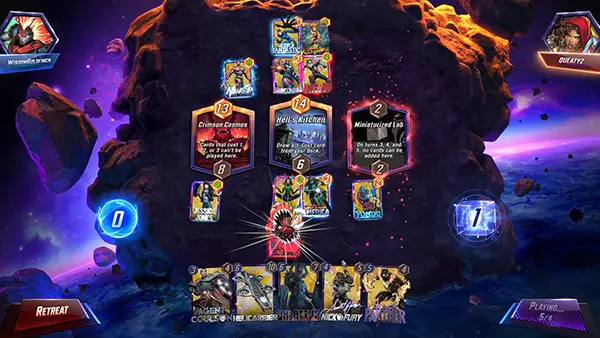
Cubes are the true currency of Marvel Snap, not individual match wins. Ranking progression depends on how effectively you manage risk across many games, rather than how often you win single matches.
Smart snapping is based on information, not optimism. A strong opening hand, favourable locations, or a clear matchup advantage are valid reasons to increase stakes. Snapping without these factors usually leads to unnecessary losses.
Equally important is disciplined retreating. Leaving a game early for a one-cube loss preserves rank and time, allowing you to play more favourable matches instead of gambling on unlikely outcomes.
Decks that reveal their win condition early benefit from assertive snapping. Linear strategies with predictable power spikes allow confident cube investment when conditions are met.
More complex decks with hidden synergies should focus on minimising losses until the final turns. These lists often retreat more often but compensate by winning larger cube totals when the setup succeeds.
Over a full season, consistent cube efficiency matters more than peak win rates. Decks designed with clear snap and retreat thresholds outperform flashy but inconsistent builds.